
Sponsored – Est. Read 8 Min
Silicon Valley’s Top Chip Incubator Just Backed This Little-Known Company… Their First-Ever Public Company Investment
With a $200 million business portfolio inside a $9 million company — and an AI prototype powered by Arm — Edgewater Wireless (TSXV: YFI); (OTC: KPIFF) appears poised to soar.
This could be one of the most mispriced tech stocks on the market – but not for long…
…What if you could invest in a mini-Broadcom
before it takes off!!
In the tech world, there’s one thing that virtually everyone can agree on:
Wi-Fi always seems to fail at the worst possible moment.
Your Zoom call freezes…your gaming session lags…the file you’re downloading just crawls along…or the movie you’re watching buffers endlessly.
It’s incredibly frustrating. And it’s become such a normal part of life that most people simply chalk it up to bad luck.
But there’s a simple reason this keeps happening:
Wi-Fi has never been designed for the way we use it today.
The entire system that Wi-Fi is built on is essentially a single-lane road that every device in your house must share.
25 years ago – when this technology first rolled out – that wasn’t a big deal, since the average home had maybe one computer and a printer.

But today the average household runs more than 17 Wi-Fi devices, from laptops and gaming consoles to TVs, smart speakers, appliances, security cameras, thermostats, baby monitors, doorbells…and the list keeps growing.
What it means is that a single-lane system simply cannot handle this newer, multi-lane traffic.
Service providers know this better than anyone. Up to 75% of customer care calls now stem from Wi-Fi problems. This means companies are literally paying the price for an outdated design that the industry has never been able to fix.
Until now.
One small fabless semiconductor and IP licensing company, Edgewater Wireless (TSXV: YFI); (OTC: KPIFF), has spent years developing and patenting an entirely new approach to Wi-Fi.

Edgewater Wireless has built the industry’s first-ever multi-lane architecture, known as Spectrum Slicing™.
Instead of one lane shared by every device, Spectrum Slicing splits the wireless spectrum into multiple concurrent lanes, dramatically boosting capacity and cutting congestion at the source.
Spectrum Slicing is proven technology that has been validated at massive scale.

In partnership with Liberty Global, one of the world’s largest broadband operators, Edgewater Wireless analyzed 6 million real-world devices across 750,000 homes.
The results were staggering: 7-18x faster performance, 50% lower latency…and the technology worked with devices the customers already owned.
And those same gains were later replicated with Edgewater Wireless’ beta silicon.
The company’s Wi-Fi breakthrough has proven in the real world – not just in a lab – that it can solve problems the entire Wi-Fi industry has struggled with for decades.
For investors, the upside could be substantial.
An independent third-party valuation pegged Edgewater Wireless’ business portfolio at $150 to $200 million.
Apple has done an IP deal with the company. Silicon Valley’s most influential chip incubator just made them their first-ever public company investment. And comparable Wi-Fi semiconductor companies have sold for $315 million to over $1 billion.
Yet for the time being, Edgewater Wireless (TSXV: YFI); (OTC: KPIFF) trades at a market cap of roughly $9 million.
That’s the kind of disconnect that doesn’t stay hidden
7 Reasons
Why a $9 Million Market Cap May Not Last Long for Edgewater Wireless (TSXV: YFI); (OTC: KPIFF)
1) A Multi-Billion-Dollar Problem the Industry Has Never Solved…Until Now
Every home fights the same battle: too many devices on a single, congested Wi-Fi channel. It’s the reason up to 75% of service provider support calls are Wi-Fi-related…and it’s a problem that costs operators millions annually. Spectrum Slicing™ fixes this at the source, turning single-lane Wi-Fi into a multi-lane superhighway… something legacy Wi-Fi simply cannot do. For service providers desperate to cut costs and reduce churn, multi-lane Wi-Fi is the only path forward. And Edgewater Wireless holds the patents.
2) Proven Technology Validated by Data From 750,000 Real Homes
Most Wi-Fi technologies get tested in pristine lab environments with new hardware. Edgewater Wireless did the opposite. In partnership with Liberty Global, one of the world’s largest broadband operators, they analyzed 6 million devices across 750,000 actual homes. This validation included real interference, mixed-age hardware, and everyday congestion. The results were beyond impressive, with 7–18× faster performance and 50% lower latency. Those gains were later replicated with Edgewater’s beta silicon. For Edgewater Wireless, the validation phase is over…the proof already exists.
3) A Business Portfolio Valued at $150-200 Million…Inside a $9 Million Market Cap Company
An independent third-party valuation placed Edgewater’s IP between $150M and $200M, yet the company’s entire market cap sits around $9 million. That gap alone should soon attract attention from Wall Street. Edgewater Wireless holds more than 26 granted patents that form a tight ring fence around multi-lane Wi-Fi, which means competitors who want to build it will need to license it from Edgewater Wireless. And here’s where it gets really interesting: Wi-Fi 8 is tracking toward Edgewater‘s narrative – away from burst-rate speed to high reliability for more devices – and it could use techniques patented by Edgewater years ago. If their IP becomes standards-essential, this could transform into a global royalty stream on every Wi-Fi chip shipped. Think of it as the chance to invest in a mini-Broadcom before it takes off.
4) Apple Already Acquired Their IP…And They May Be Just the First
Multi-lane Wi-Fi doesn’t exist in the market today. The entire industry has been built on single-lane architecture for 25 years. Edgewater Wireless owns the patents that make multi-lane possible, which means any company that wants to build it will likely need to license from Edgewater first. Apple has done an IP deal with the company. Silicon Valley’s most influential chip incubator just made them their first-ever public company investment. These partners found Edgewater Wireless and others are likely to follow. As Wi-Fi 7 and 8 push the industry toward multi-link architectures, Edgewater’s licensing pipeline could expand significantly.
5) Silicon Valley’s Top Chip Incubator Just Made This Company Its First-Ever Public Company Investment
Silicon Catalyst is one of the most influential semiconductor accelerators in the world. Their backers include Taiwan Semiconductor Manufacturing Company (TSMC), which manufactures a majority of the world’s chips, along with NXP, Synopsys, and Arm. They typically work only with private Silicon Valley startups valued at $50-100 million or more. In the second half of 2024, Edgewater Wireless became the first publicly traded company they’ve ever backed. Along with that vote of confidence comes access to over $3 million in development tools and services, plus direct relationships with the partners who power the global semiconductor industry.
6) A 40% Rebate on R&D Spending…Plus Millions More in Potential Support
Canada’s FABrIC initiative, the country’s answer to the U.S. CHIPS Act, refunds up to 40% of Edgewater’s R&D and commercialization spending. Additional government programs could provide another $5-7 million in support. For a company with a $9 million market cap, that kind of backing changes the math entirely. Edgewater Wireless gets to move faster and stretch every development dollar further than investors might expect.
7) A $9 Million Valuation That Doesn’t Add Up…And Near-Term Catalysts That Could Change It
Edgewater Wireless (TSXV: YFI); (OTC: KPIFF) trades at roughly $9 million…a valuation typically reserved for pre-product startups with unproven concepts. But Edgewater has field-proven technology validated across 750,000 homes, a business portfolio independently valued at up to $200 million, an AI-prototype powered by ARM to design next-gen technology, and backing from Silicon Valley’s top semiconductor incubator. Meanwhile, comparable Wi-Fi chip companies have been acquired for $315 million to over $1 billion. The gap between what Edgewater Wireless has accomplished and where the market has it priced tends to attract attention quickly once investors notice it. And with a next-generation silicon prototype expected in the first half of 2026, that gap may not last long.
A Billion-Dollar Problem Hiding in Plain Sight…
And Edgewater Wireless (TSXV: YFI); (OTC: KPIFF)
Has the Solution
Wi-Fi is everywhere. It’s in our homes, our offices, our hotels, our hospitals. It’s the invisible backbone of modern life…and it’s fundamentally broken.
The problem goes back 25 years. When Wi-Fi was first designed, a home might have had one or two connected devices. The architecture made sense: a single channel that devices take turns using. It was simple and efficient…and good enough for the times.
But the world changed – in a huge way.
Today the average home runs 17 or more Wi-Fi devices, all competing for that same single lane. Laptops, phones, tablets, TVs, gaming consoles, smart speakers, security cameras, thermostats, doorbells…the list keeps growing. And every new device makes the congestion worse.
The Problem
The world added smart devices, but Wi-Fi never evolved to handle them leaving service providers with rising costs and frustrated customers.
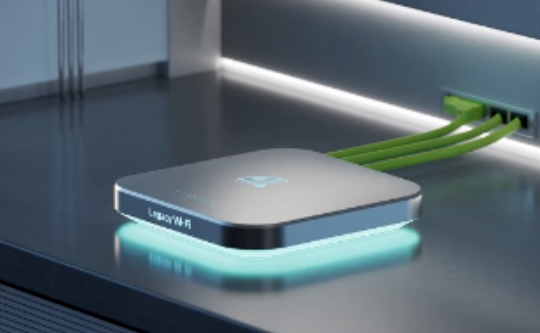
Legacy Wi-Fi is broken
Wi-Fi devices operate on a narrow single channel causing congestion and latency.

Poor user experience
75% of Service Provider customer service calls are Wi-Fi related.

Growing device demand
Average home now has 17+ Wi-Fi devices competing for bandwidth and growing.
Service providers feel this pain more than anyone. Up to 75% of their customer support calls are Wi-Fi related.
That translates into millions of dollars every year in support costs and lost revenue…in a business where margins matter just as much as subscriber counts. They’ve tried everything, including faster speeds, wider channels and mesh networks. But none of it solves the underlying problem.
The architecture itself is the bottleneck. You can’t fix a traffic jam by raising the speed limit. You need more lanes.
That’s exactly what Edgewater Wireless (TSXV: YFI); (OTC: KPIFF) built.
Spectrum Slicing™: The Multi-Lane Architecture Redefining the Future of Wi-Fi
To solve the world’s rapidly-growing Wi-Fi problem, Edgewater Wireless did not simply try to patch the old system…they rebuilt it from the silicon up.
Their patented Spectrum Slicing™ technology divides a traditional single Wi-Fi channel into multiple concurrent links, transforming the congested single-lane road into a multi-lane highway. More lanes means more devices can transmit simultaneously, which dramatically reduces congestion and cuts latency at the source.
The Multi-Lane Wi-Fi Solution

The Most Valuable Wi-Fi Innovation That Can’t Be Ignored – And Why

Spectrum Slicing™
Turns single-lane WiFi into a multi-lane superhighway.

AI-Enabled
Dynamically configures optimal channel setup using real-time spectral awareness.

10X Performance
Maximum performance for all devices – legacy and new — with fewer access pints required.

Lower Costs
Fewer access points and less customer service requests.
Think of it this way: legacy Wi-Fi is like a one-lane road where every car has to wait its turn. Add more cars and traffic grinds to a halt. Spectrum Slicing opens up multiple lanes so traffic flows freely, even as more vehicles enter the road.
That’s why Edgewater’s tests showed 7-18× faster performance and 50% lower latency. The architecture eliminates the bottleneck rather than trying to work around it.
The technology is also AI-enabled. Edgewater’s system dynamically optimizes channel configuration in real time, adjusting to interference and congestion as conditions change inside the home or business. Unlike static setups that work well on day one and degrade over time, Edgewater’s system continuously adapts to deliver consistent, reliable performance.
And critically, Spectrum Slicing works with all existing Wi-Fi standards, including Wi-Fi 7 and the coming Wi-Fi 8.
That means service providers and enterprises don’t need to rip and replace their current infrastructure or wait for customers to buy new devices. The performance gains work with equipment already deployed in the field, which dramatically lowers the barrier to adoption.
For service providers, that translates to fewer support calls, lower operating costs, and reduced customer churn. For enterprises and industrial IoT deployments, it means the kind of ultra-high reliability that current Wi-Fi struggles to deliver…and the difference between a network that works most of the time and one that works all the time.
The opportunity is massive. Edgewater is targeting a $10 billion segment within the $30+ billion global Wi-Fi semiconductor market…across residential, enterprise, and industrial IoT applications.
For investors, it comes down to this: Edgewater holds 26+ patents protecting this architecture, with four additional AI-related patents pending. And as the industry moves toward the multi-link, multi-lane designs at the heart of Wi-Fi 7 and Wi-Fi 8, Edgewater’s IP sits directly in the path of where the entire market is headed.
The bottom line: Edgewater saw where Wi-Fi needed to go years before the rest of the industry caught on. Now they hold the IP that could make multi-lane Wi-Fi possible for everyone else.
Real-World Proof: Edgewater Wireless’ Technology Has Been Validated Where It Matters Most
Lab tests are great, but real-world Wi-Fi deployments, where interference and capacity have a massive impact on performance, are the real benchmark. Edgewater Wireless has cleared that bar.
The most significant validation came through a partnership with Liberty Global, one of the world’s largest broadband operators and the support of its partner, CableLabs, which is the global R&D arm of the cable industry.
In a large-scale Proof of Concept, Edgewater Wireless analyzed 6 million devices across 750,000 actual homes. The environment was messy by design, including mixed-age hardware, neighborhood interference, and the kind of congestion that breaks traditional Wi-Fi.
Real-World Example – Liberty Global
Larger-scale PoC tapped real-world residential Wi-Fi performance data for millions of devices and compared legacy, single-channel WiFi architecture to Wi-Fi Sectrum Slicing
Proof of Concept
6M connected devices in 750k households analyzed
Results
7-18X performance gaines in 75% of homes compared to legacy Wi-Fi
——————–
Pilot
Deployed Edgewater reference design in independent test lab to to replicate PoC environment
Results
Mirrored performance gains from PoC and delivered 50% lower latency

Liberty Global discovered a critical insight: wide, clean channels are rarely available in real residential settings, which makes traditional approaches to Wi-Fi increasingly ineffective.
Spectrum Slicing proved to be the only scalable solution, delivering 7-18× faster performance and 50% lower latency even in the most congested environments. Those results were later replicated with Edgewater’s beta silicon.
But Liberty Global wasn’t the only validation.
* CableLabs, the global R&D arm of the cable industry, has partnered with Edgewater Wireless to explore how Spectrum Slicing can reshape the Wi-Fi market for service providers and device manufacturers.

* Mediacom deployed Edgewater technology at the 500-acre WaterColor Inn & Resort in Florida, delivering seamless guest connectivity in one of the most challenging environments for wireless coverage.

* Kroger tapped Edgewater to power a next-generation in-store Wi-Fi platform intended to improve shopper connectivity and in-store operations.

* And at the Valhalla Music Festival, Edgewater solved the ultimate high-density challenge – the challenge of thousands of simultaneous users in an interference-heavy environment – with drastically fewer access points.
This kind of validation across multiple industries and use cases is rare at this stage. Most companies this size are still trying to land their first proof of concept.
The Valuation Gap: Why a $9 Million Market Cap Doesn’t Add Up
Here’s where the math gets interesting for investors.
Edgewater’s business portfolio has been independently valued at $150 to 200 million. And comparable Wi-Fi semiconductor companies have been acquired for significant premiums.



For example, Celeno sold to Renesas for $315 million, and Quantenna Communications was acquired by ON Semiconductor (Nasdaq: ON) for more than $1 billion.
Both were fabless Wi-Fi chip companies, just like Edgewater Wireless (TSXV: YFI); (OTC: KPIFF).
Yet Edgewater’s entire market cap sits around $9 million.
That’s a disconnect that’s hard to explain…especially for a company with field-proven technology, 26+ granted patents, an AI prototype powered by ARM to design next-gen technology, and backing from Silicon Valley’s top semiconductor incubator.
So how does Edgewater Wireless plan to capture the value locked in that IP? Through three complementary revenue streams.
The Business Model
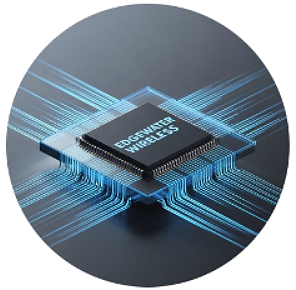
Silicon Solutions
Wi-Fi Spectrum Slicing silicon solutions for residential and enterprise applications.
Demonstrated traction with Service Provider & Enterprise pilots.

IP Licensing
26+ granted patents across wireless technologies with AI optimization.
First IP licensing customer: Apple.
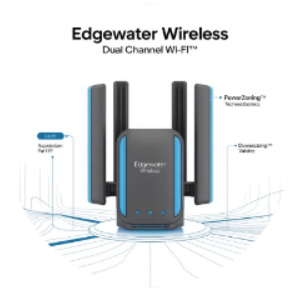
Reference Designs Acess Point Solutions
Wi-Fi Specturm Slicing powered Access Point solutions with highly differentiated capabilities.
Turn-key manufacturing for OEMs.
1. Silicon Sales
Edgewater’s chips are designed for residential gateways, enterprise access points, and industrial IoT applications. Once a chip is designed into a platform, it generates recurring revenue for years with gross margins in the 60-80% range.
And the revenue potential is substantial. A single service provider contract can run 10-20 million units over a 4-5 year cycle at $20-25 per unit…with 60% to 80% gross margins.
Edgewater has already secured a letter of intent for an Industrial IoT product and is targeting multiple service providers and manufacturers for their WiFi7 Spectrum Slicing platform.
2. IP Licensing
Edgewater can license its patented multi-lane technology to competitors who want to build Spectrum Slicing into their own products.
And the company has added an award-winning patent-licensing expert with decades of proven experience to its Board of Directors, positioning itself for significant upside potential in the IP licensing space.
3. Reference Designs
For manufacturers who want turnkey solutions, Edgewater offers fully integrated access point designs powered by Spectrum Slicing. This provides a faster path to market for OEMs without deep Wi-Fi expertise.
Impressively, Edgewater Wireless has built multiple paths to revenue around a single proprietary technology.
Other companies in the space – including private startups with little more than a PowerPoint presentation to their name – are valued at $50 to $100 million.
Yet the current valuation of just $9 million for Edgewater Wireless as a publicly-traded company suggests the market hasn’t caught on to any of the company’s paths to revenue…and certainly isn’t aware of the potential $150-200 million value of the company’s business portfolio.
Edgewater Wireless Has Strategic Backing Well Beyond Its Current $9 Million Market Cap
Edgewater has assembled the kind of partnerships and support structure that companies at this stage rarely have.
Silicon Catalyst, one of the most influential semiconductor incubators in the world, backed by TSMC, NXP, Synopsys, and Arm, made Edgewater their first-ever public company investment in 2024.
That relationship brings access to over $3 million in development tools and services, plus direct connections to the partners who power the global chip industry.
Through Silicon Catalyst, Edgewater also developed an AI-prototype powered by Arm, whose IP is embedded in roughly 98% of mobile devices worldwide. That deal alone saved the company an estimated $2 million in licensing costs.
Strategic Partnerships and Government Programs
Strategic partnerships provide Edgewater with access to global ecosystems, millions in in-kind services, and accelerated time-to-market with reduced risk.
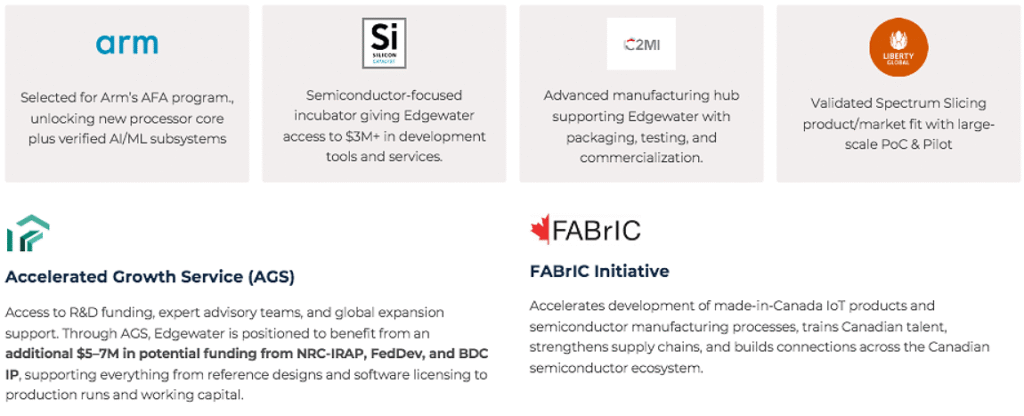
On the government side, Canada’s FABrIC initiative, which is the country’s answer to the U.S. CHIPS Act, refunds 40% of Edgewater’s R&D and commercialization spending. Additional programs could provide another $5-7 million in support.
“Edgewater Wireless Wins Strategic Federal Grant for Advanced
Wi-Fi Chip Commercialization”[iv]
In an era when chip supply chains have become a geopolitical priority, Edgewater Wireless is already ahead of the curve. Their entire production ecosystem is onshored to North America: design in Ottawa, fabrication with GlobalFoundries in Vermont, and packaging with IBM in Quebec.
For both customers and governments, who are increasingly wary of overseas chip dependence, that’s a competitive advantage that’s hard to replicate.
As for what’s ahead, the company expects to launch its next-generation silicon prototype in the first half of 2026, a key milestone that typically draws serious attention from larger semiconductor players. Industry endorsements and strategic hires are also expected in the coming months.
Leading the charge for Edgewater Wireless is CEO Andrew Skafel, a 20-year technology industry veteran with experience at Newbridge and Alcatel. He’s supported by VP of Product Eric Smith and VP of Engineering Donovan Wallace, who brings 25+ years of experience bringing wireless and semiconductor products to market. The board includes Jim Skippen, the former CEO of WiLAN and one of the world’s most recognized IP licensing strategists, along with seasoned investment bankers Brian Imrie and Ralph Garcea.
This is a team that has built, scaled, and exited technology companies before…and they’re structured to do it again.
Investor Summary:
A Rare Convergence of Validation, Protection, and Opportunity
Edgewater Wireless offers something investors rarely see at this stage: proven technology, protected IP valued at $150-200 million, and a market cap of roughly $9 million that suggests the market hasn’t caught up yet.
The company has done what most small-cap tech plays never accomplish. They’ve proven their technology works…in 750,000 real homes with 6 million devices. They’ve secured a partnership with ARM to design next-gen technology. They’ve earned backing from Silicon Valley’s top semiconductor incubator. And they’ve locked up 26+ patents around an architecture the entire Wi-Fi industry is moving toward.
One catalyst in particular could change everything: if Edgewater’s patents become standards-essential in Wi-Fi 8, the company could earn royalties on every Wi-Fi chip shipped globally. That’s a potential game-changer for a company trading at just $9 million right now.
Comparable companies in this space have been acquired for $315 million to over $1 billion. Edgewater Wireless trades at a fraction of those figures, despite holding what may be the key IP for the next generation of Wi-Fi.
With a next-generation silicon prototype expected in the first half of 2026 and the Wi-Fi 7/8 standards cycle accelerating, the catalysts are lining up.
For investors looking at small-cap technology opportunities, the gap between what Edgewater Wireless (TSXV: YFI); (OTC: KPIFF) has accomplished and where the market has it priced may represent one of the highest-upside opportunities available today.
[i] https://www.eetimes.com/renesas-buys-celeno-for-315-million/
[ii] https://www.marketwatch.com/story/on-semiconductor-to-acquire-
quantenna-for-just-over-1-billion-
2019-03-27?gaa_at=eafs&gaa_n=
AWEtsqdnaYj5PnqCiWcuh1dxo2ksZKZKBRfRaH69ap-
oGWb_1RSkTuYsScaAs_9VB2g%3D&gaa_ts=69274523&gaa_sig=
OYgYTQ6ijgSwqclwnH
gmFprtPXAb-R7tyiMlTCkTgbnRL-
ASDxvoLQWLBy_fZGfdIfGPFsgr0vvmHcaM718qdQ%3D%3D
[iii] https://www.cnet.com/tech/tech-industry/qualcomm-to-buy-atheros-for-3-1-billion/
[iv] https://edgewaterwireless.com/edgewater-wireless-wins-strategic-federal-grant-for-advanced-wi-fi-chip-commercialization/
[v] https://www.ft.com/content/446ebefe-1b8e-4e2d-9bff-6110fcac2dfc
[vi] https://www.whitehouse.gov/presidential-actions/2025/02/addressing-the-threat-to-nationalsecurity-from-imports-of-copper/
Full Disclaimer:
This website/newsletter is owned, operated and edited by Jade Cabbage Media LLC. Any wording found in this e-mail or disclaimer referencing “I” or “we” or “our” or “Jade Cabbage” refers to Jade Cabbage Media LLC. This webpage/newsletter is a paid advertisement, not a recommendation nor an offer to buy or sell securities. Our business model is to be financially compensated to market and raise awareness for small public companies.
By reading our newsletter and our website you agree to the terms of our disclaimer, which are subject to change at any time. We are not registered or licensed in any jurisdiction whatsoever to provide investing advice or anything of an advisory or consultancy nature and are therefore unqualified to give investment recommendations. Always do your own research and consult with a licensed investment professional before investing. This communication is never to be used as the basis for making investment decisions and is for entertainment purposes only. At most, this communication should serve only as a starting point to do your own research and consult with a licensed professional regarding the companies profiled and discussed. Conduct your own research. Companies with low price per share are speculative and carry a high degree of risk, so only invest what you can afford to lose. By using our service you agree not to hold our site, its editor’s, owners, or staff liable for any damages, financial or otherwise, that may occur due to any action you may take based on the information contained within our newsletters or on our website.
We do not advise any reader to take any specific action. Losses can be larger than expected if the company experiences any problems with liquidity or wide spreads. Our website and newsletter are for entertainment purposes only. Never invest purely based on our alerts. Gains mentioned in our newsletter and on our website may be based on end-of-day or intraday data. This publication and their owners and affiliates may hold positions in the securities mentioned in our alerts, which we may sell at any time without notice to our subscribers, which may have a negative impact on share prices. If we own any shares we will list the information relevant to the stock and number of shares here. The Jade Cabbage Media business model is to receive financial compensation to raise awareness for public companies.
Pursuant to an agreement between Winning Media LLC and the issuer, Edgewater Wireless Systems Inc. (YFI), Winning Media LLC has been hired for a period beginning on 12/31/25 and ending on 1/31/26 to conduct investor relations advertising and marketing and publicly disseminate information about Edgewater Wireless Systems Inc. (YFI) via Website, Email and SMS. Winning Media has been compensated the sum total of twenty five thousand dollars via bank wire transfer. Furthermore, Winning Media LLC has paid up to fifteen thousand dollars to Jade Cabbage Media LLC to manage the production budget and digital media campaign for Edgewater Wireless Systems Inc. (YFI).
We expect to receive additional compensation as the investor awareness continues. We will disclose every amount we receive. We own zero shares of Edgewater Wireless Systems Inc. (YFI). This compensation is a major conflict of interest in our ability to be unbiased regarding. Therefore, this communication should be viewed as a commercial advertisement only.
We have not investigated the background of the hiring party. The third party, profiled company, or their affiliates likely wish to liquidate shares of the profiled company at or near the time you receive this communication, which has the potential to hurt share prices. Any non-compensated alerts are purely for the purpose of expanding our database for the benefit of our future financially compensated investor relations efforts. Frequently companies profiled in our alerts may experience a large increase in volume and share price during the course of investor relations marketing, which may end as soon as the investor relations marketing ceases. Our emails may contain forward-looking statements, which are not guaranteed to materialize due to a variety of factors
We do not guarantee the timeliness, accuracy, or completeness of the information on our site or in our newsletters. The information in our email newsletters and on our website is believed to be accurate and correct, but has not been independently verified and is not guaranteed to be correct. The information is collected from public sources, such as the profiled company’s website and press releases, but is not researched or verified in any way whatsoever to ensure the publicly available information is correct. Furthermore, Jade Cabbage and Winning Media often employs independent contractor writers who may make errors when researching information and preparing these communications regarding profiled companies. Independent writers’ works are double-checked and verified before publication, but it is certainly possible for errors or omissions to take place during editing of independent contractor writer’s communications regarding the profiled company(s). You should assume all information in all of our communications is incorrect until you personally verify the information, and again are encouraged to never invest based on the information contained in our written communications. The information in our disclaimers is subject to change at any time without notice. Please invest carefully and read investment information available at the website of the SEC at http://www.sec.gov.