
Sponsored – Est. Read 7 Min – Distributed on Behalf of Conavi Medical
A Global Giant Just Paid $265 Million for HALF of What This C$20 Million Company Owns…
In January 2026, healthcare giant Philips paid more than a quarter of a billion dollars for a Massachusetts company with about 70 employees.
The company it acquired was SpectraWAVEI…and it had built a system that allows a cardiologist to thread a catheter into a coronary artery and see the inside of a vessel using something known as Optical Coherence Tomography, or OCT.
Philips put down $265 million in cash…added earnout payments on top of that amount…and closed the deal on January 15ii.
That is what a single one of these imaging technologies was worth to a global medical device company.
Right now a much smaller medical technology company called Conavi Medical Corp. (TSXV: CNVI); (OTCQB: CNVIF) has TWO of them.
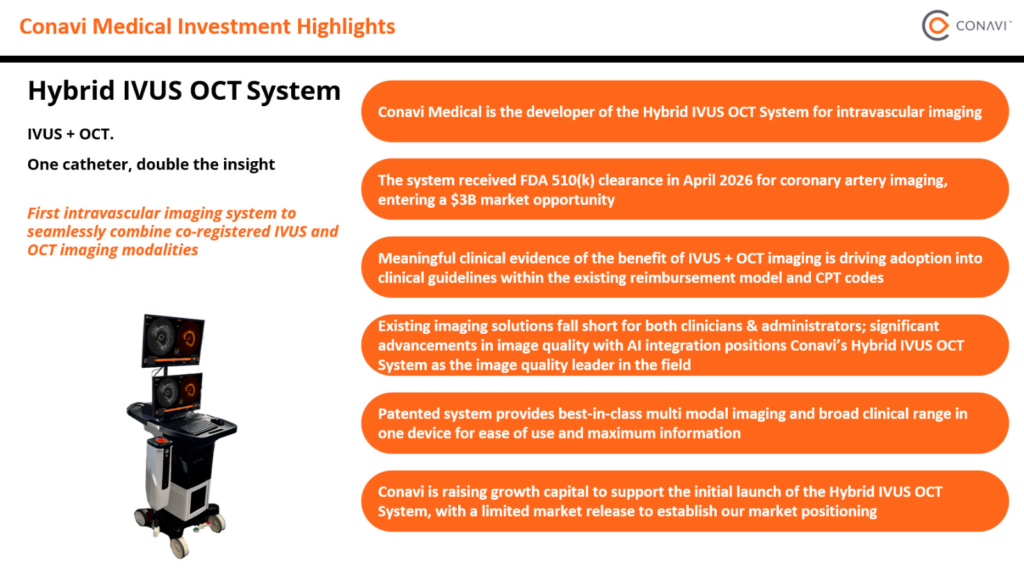
Conavi’s Hybrid IVUS OCT System carries OCT and intravascular ultrasound, or IVUS, on the same catheter. Both beams read the same slice of artery at the same instant.
Conavi’s combination of the two technologies is hugely important because they are good at opposite things. IVUS sees deep into the vessel wall and works in patients whose kidneys can’t tolerate contrast dye. OCT sees at roughly ten times the resolution but can’t see as far.
So a cardiologist who commits to one accepts blind spots the other would have caught. Conavi’s answer to this dilemma was to stop making anyone choose and bring these two together.
The FDA cleared Conavi’s next-generation Hybrid IVUS OCT System in April 2026.
Conavi spent years and a significant amount of capital building it. The market values the entire company right now at roughly C$20 million.
Those two numbers alone reveal just a portion of the opportunity with Conavi Medical Corp. (TSXV: CNVI); (OTCQB: CNVIF). The expensive part is over…the product exists…and the FDA has cleared it for sale in the United States.
What the market is charging for all of it today amounts to a small fraction of what went into creating it, which means nobody buying at today’s prices is paying for the two decades of work. Instead, you have the opportunity to pick it up after the bill was settled.
Most small medical device companies get their FDA clearance and then find out that the hard part was still ahead of them. They still need to earn a billing code, argue reimbursement into existence, publish enough evidence to change what doctors believe and then teach a new procedure to people who never asked to learn one.
That challenging process has buried more technologies over the years than it should have.
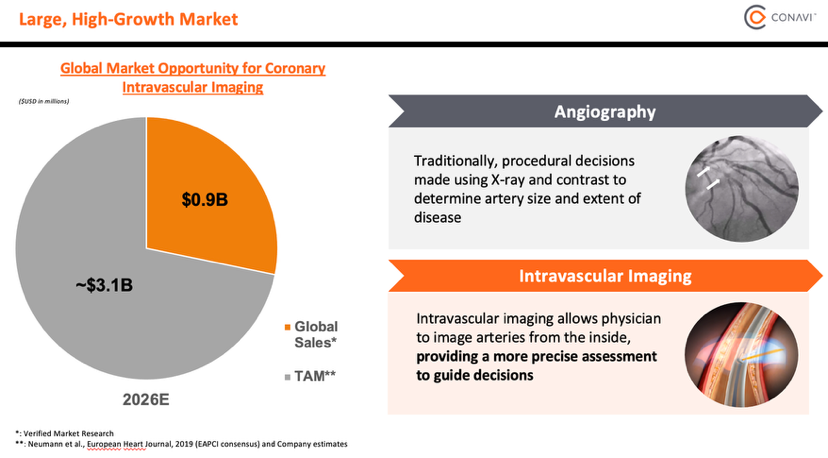
Conavi walks into a market where all of that already exists. Four million intravascular procedures happen every year, and roughly $900 million annually is spent on imaging inside those arteries. IVUS and OCT are both coded, both reimbursed and both already sitting in the hands of physicians who know how to use them.
It takes about ten things to build a market like this one…and nine of them were already done before Conavi got here.
The clinical case got stronger while Conavi was still in development. 22 randomized trials covering roughly 16,000 patientsiii compared procedures guided by intravascular imaging against procedures guided by X-ray alone…and the patients whose doctors could see inside the artery died of cardiac causes 45% less often.
Cardiology guidelines in both the United States and Europe then elevated intravascular imaging to Class 1Aiv, the highest recommendation the profession uses. But historically, less than a quarter of U.S. procedures have used it.
That 45% figure is important. This market for intravascular imaging is growing because the technology works. And “works” in this case means measurably fewer people dying of cardiac causes after their procedure.
What Conavi built is a way of seeing more of that artery and accessing more patients than either of the existing tools can on its own.
This is a potential investment where the financial arguments and the medical arguments are both pointing in the same direction…something that can be rare in the small cap space.
The development years are already behind this company…the clearance is in hand…and the financing is closed. Right now a technology that took two decades and nine figures to build is carrying a market value worth less than one-tenth of what Philips paid up front for half of it.
7 Reasons
Conavi Medical Could Be One of the Most Intriguing Small Cap Medical Technology Stocks to Watch Right Now
01
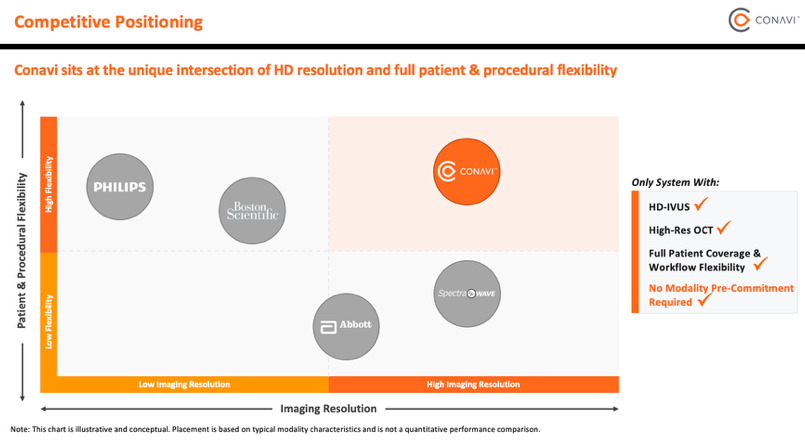
Cardiologists have spent thirty years choosing between IVUS and OCT…and now – thanks to Conavi Medical Corp. (TSXV: CNVI); (OTCQB: CNVIF) – they no longer have to.
IVUS penetrates deep enough to size the vessel and works without contrast dye. OCT resolves fine detail about ten times better and shows whether a stent seated correctly against the wall. Neither one does the other’s job.
Conavi’s Hybrid IVUS OCT System puts an OCT beam inside an ultrasound transducer at the tip of a single catheter. One pullback produces both data streams, co-registered and co-linear, meaning the two beams read the same tissue at the same instant rather than reading it a moment apart.
A peer-reviewed study published in Cardiovascular Research in March 2026v measured what a combination like Conavi’s Hybrid IVUS OCT System can deliver.
Researchers imaged donated hearts, then cut the arteries open and examined the tissue under a microscope to establish what was actually there.
Across 1,256 frames and three international core labs, hybrid IVUS-OCT classified tissue with 86.7% accuracy.
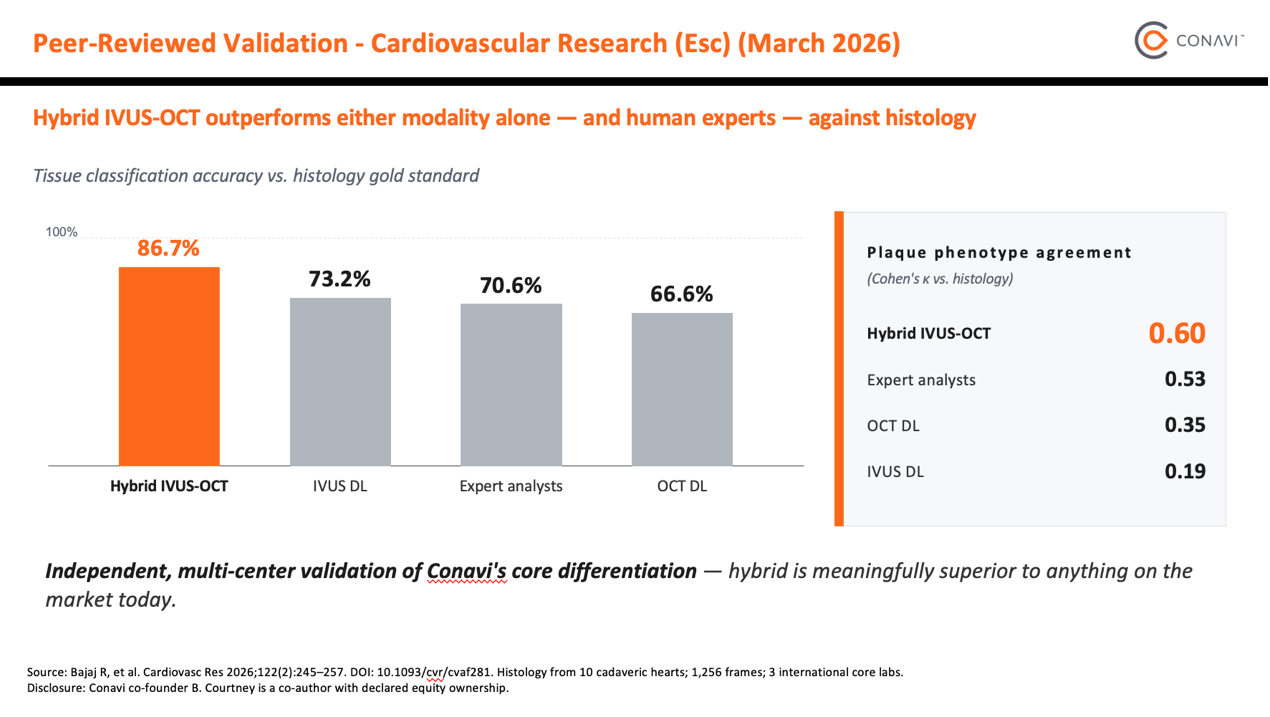
Compare that with standalone IVUS deep learning, which managed 73.2%…or standalone OCT deep learning, which managed 66.6%…or expert human analysts, who came in at 70.6%.
Terumo, the Japanese device maker, cleared its own dual-modality catheter in October 2025, which tells you the category is significant enough for a multibillion-dollar company to chase. Its two sensors sit in sequence roughly a third of a millimeter apart. Conavi’s overlap, so both views land on the same tissue by design instead of being lined up by software afterward.
What Conavi’s impressive combination of technologies means for a company this size could be game-changing. Abbott sells into hospitals that standardized on OCT. Boston Scientific sells into hospitals that standardized on IVUS. Each is fighting for a portion of the four million procedures performed every year.
Now along comes Conavi, a C$20 million company holding a product that addresses the entire market rather than fighting over a piece of it…and they’re entering this market with a technology that has proven to be superior to the one-or-the-other technologies that currently dominate the market.
02
Cardiology Changed Its Rules…and Conavi Sells the Answer
Today, a cardiologist who skips intravascular imaging is taking on a legal risk. When a stent procedure goes wrong and a lawsuit follows, the first question at trial is whether the doctor followed accepted guidelines. Those guidelines now call for imaging.
Conavi’s technology now gives a doctor both forms of imaging in a single pass, which is about as thorough a look inside the artery as anyone can document.
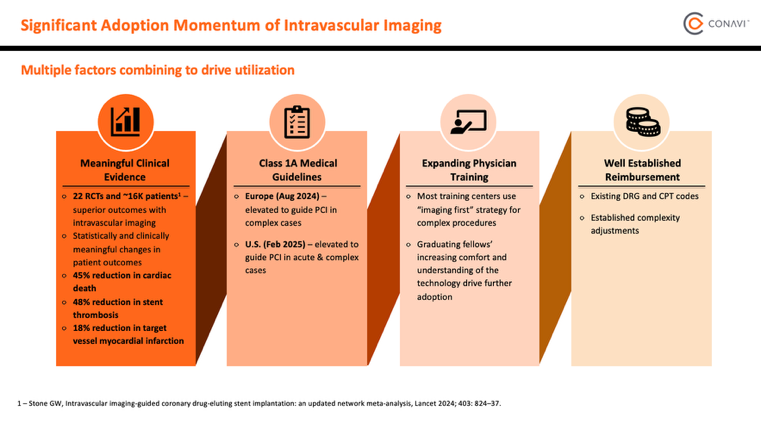
Europe made the change to its standards in August 2024 and the United States followed in February 2025. Both elevated intravascular imaging to Class 1A, the strongest recommendation cardiology issues, on the strength of 22 randomized trials covering roughly 16,000 patientsvi. Procedures guided by imaging cut cardiac deaths by 45% and stent thrombosis by 48%.
That single guideline is so important…as it turns the company’s product from something a hospital “might someday want” into something a doctor has to answer for skipping.
Fewer than 25% of U.S. procedures currently use intravascular imaging, up from the low teens just a few years agovii. Three quarters of the market is still doing it the old way.
That means there’s a potentially massive opportunity right now for Conavi’s technology.
Coronary intravascular imaging is already about a $900 million a year business worldwide, and industry experts project that the addressable market could reach $4 billion as adoption catches up to what the guidelines now recommend.
A market that size means a company like Conavi Medical Corp. (TSXV: CNVI); (OTCQB: CNVIF) – again, currently valued by the market at C$20 million – only needs to seize a modest portion of the market in order to potentially deliver strong upside.
03
One of the most overlooked parts of the Conavi story may actually prove to be the most valuable.
New medical technology usually dies somewhere between the time it gets regulatory clearance and time it reaches adoption.
You’ve seen this movie before: a company gets its FDA news and then the stock pops. But after that, the real work becomes a grind.
The company needs to apply for a CPT code, collect the data the code requires, negotiate reimbursement language, negotiate payment amounts, fund the clinical evidence, train the physicians…and more.
Years pass during this period and many times, the cash runs out.
Fortunately, none of that is an issue in the case of Conavi.
Both IVUS and OCT have been reimbursed for over a decade, with the billing codes and hospital payment adjustments long since settled. Fellows come out of training already fluent in both.
And Abbott, Boston Scientific and Philips spent years and enormous sums building the clinical evidence that changed the guidelines in the first place.
Now along comes Conavi with its game-changing technology ready to deliver into a market that has already been well established. It’s the kind of head start most companies can only dream about.
04
Conavi Offers One System…With No Blind Spots
Every intravascular imaging system on the market today has patients it cannot serve, and the gaps can be significant.
OCT needs a flush of contrast dye to push the blood out of the way before the laser can see anything. That rules it out for patients with damaged kidneys, and it runs into trouble in the largest vessels, at the openings where arteries branch off the aorta and in arteries that are completely blocked.
IVUS has none of those limitations. But what it lacks is resolution, so it struggles to show a blood clot, a tear in the vessel wall or whether the edge of a stent is seated flush against the tissue.
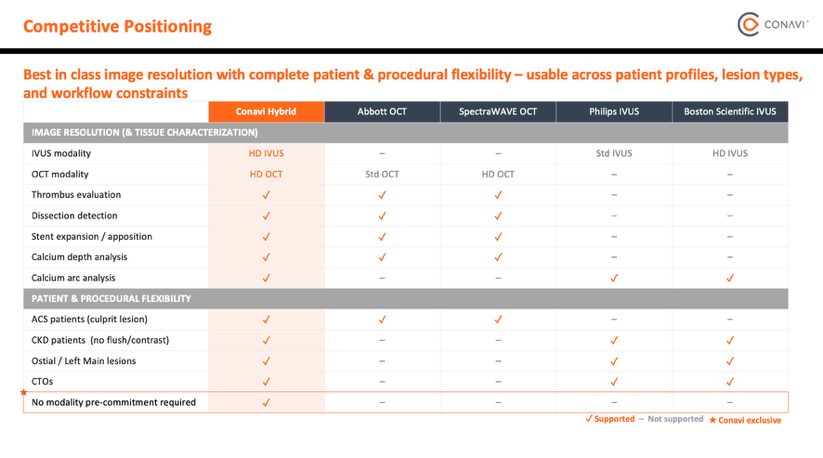
Conavi lined its system up against Abbott’s OCT, SpectraWAVE’s OCT, Philips’ IVUS and Boston Scientific’s IVUS across ten clinical capabilities. Conavi’s is the only one of the five with a mark in every row.
That comparison really shows why the hybrid system is so demonstrably superior. A cath lab running an OCT system falls back on something else when a kidney patient comes through the door. A cath lab running IVUS gives up the detail that shows whether the stent actually seated.
The Conavi system covers both columns, which is why no one using it has to decide which kind of case they are walking into before the catheter goes in.
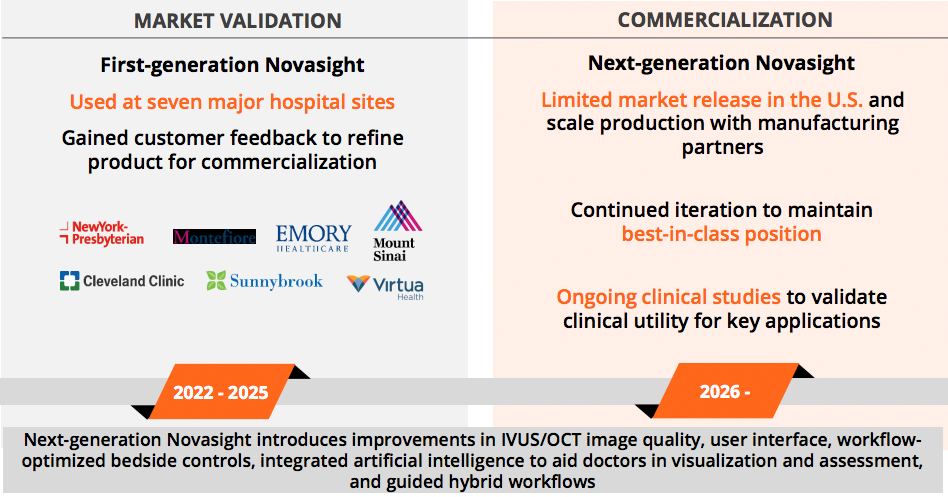
More importantly, none of this sat in a lab waiting for a customer. Conavi spent years putting the system in front of physicians at seven major hospital sites and reworking the product around what came back.
Selling one console instead of two, or one catheter instead of two, makes for an easier “yes.” And an easier “yes” is what gives a company valued at C$20 million a real shot at accounts Abbott and Boston Scientific defend with sales forces many times its size.
05
Conavi received FDA 510(k) clearance for its next-generation Hybrid IVUS OCT System in April 2026viii. That was a rebuilt system – a 60MHz ultrasound, improved optical depth, AI-assisted image segmentation system.
In other words…that was a design meant to be manufactured at scale rather than assembled one unit at a time.
Over the next few years, we’ll see what that system can carry. Conavi has four programs in development, all built on that same system.
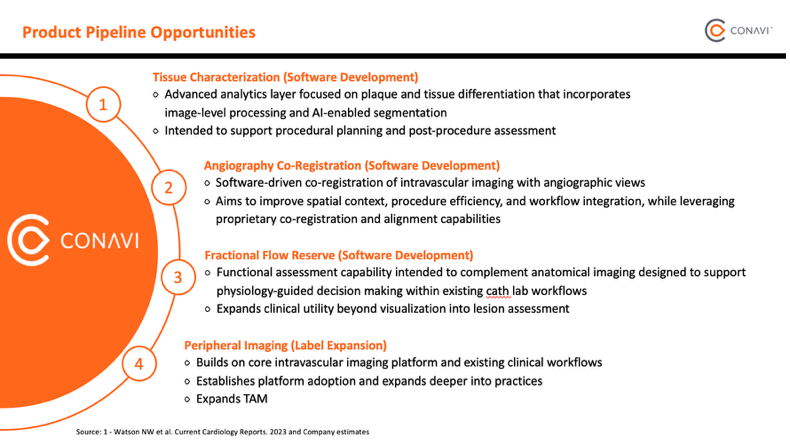
One program is a label expansion into peripheral imaging, which points the same platform at arteries outside the heart and widens the addressable market without requiring a new device.
The other three are software: fractional flow reserve to gauge how much a blockage actually restricts blood flow, co-registration with the angiography views a cardiologist is already looking at, and an AI layer for plaque and tissue characterization.
The AI work is important for another reason: Software gets copied and eventually commoditized. But what is more difficult to copy is the data feeding it, and a catheter reading the same tissue two ways at once produces a richer data set than either modality generates alone.
Conavi closed a $12 million public offering in Januaryix and holds clearance in the United States. This means the company’s pipeline is a funded platform for potential growth…not simply a wish list for the future.
06
Here’s where the Conavi story gets especially interesting from an investment perspective…
SpectraWAVE developed an advanced OCT imaging platform, cleared it with the FDA in 2023, raised $50 million in 2024 and began its limited market release in early 2025.
Philips agreed to buy the company that December. The deal closed on January 15, 2026 with the terms disclosed as $265 million paid up front from cash on hand, plus contingent consideration on top of thatx.
Of course, that news is not an assurance that Conavi would get bought out, or that it would fetch a comparable number if it did.
What the Philips-SpectraWAVE buyout does establish, however, is a recent, documented price that a global medical device company was willing to pay for differentiated coronary imaging technology in the hands of a company with roughly 70 employees.
Philips, Abbott and Boston Scientific each hold a piece of this market…yet as of right now there are very few independent companies left in the category worth owning.
Conavi Medical Corp. (TSXV: CNVI); (OTCQB: CNVIF) is one of them.
Conavi holds a cleared hybrid system, a peer-reviewed result no standalone product has matched, patents covering the co-registration that makes the whole thing work and a platform with four programs running on top of it.
SpectraWAVE had one imaging technology and a few dozen employees when a global giant paid a quarter of a billion dollars for it.
07
Perhaps the most striking number in the entire Conavi story isn’t the amount Philips paid for SpectraWAVE.
A significant amount of capital has gone into developing this technology over the years: two generations of product, two FDA clearances and the patents underneath them.
Yet Conavi’s market value currently sits near C$20 million.
Anyone buying shares now is not funding that development. It’s already been funded.
Instead, you’d be stepping in after the money was spent, after the second-generation system was built, after the FDA cleared it and after cardiology guidelines shifted in the technology’s favor.
The six reasons outlined above make the case for what Conavi built. But this one is about what the market is charging for it…and those two numbers don’t often sit this far apart.
The Bottom Line:
The story for Conavi Medical Corp. (TSXV: CNVI); (OTCQB: CNVIF) really boils down to a handful of facts:
Conavi’s breakthrough means that two imaging technologies cardiologists have been choosing between for thirty years now sit on one catheter, reading the same tissue at the same instant.
And Conavi Medical Corp. (TSXV: CNVI); (OTCQB: CNVIF) carries a market value near C$20 million.
What makes the potential upside for Conavi so impressive is the difference between those last two numbers.
Gaps like that tend to close in one direction or the other. Either the technology never finds its footing, or the market works out what nearly twenty years and $100 million actually produced. The people who funded that work absorbed the risk that came with it. Anyone stepping in at today’s price inherits what they built without inheriting the bill.
A company carrying a C$20 million valuation does not have to take this entire market to reward the people who own it.
Instead, it simply has to win a sliver of a $900 million business that the guidelines are pushing toward four billion…with a unique, game-changing technology that was built to cover ground the standalone systems cannot.
i https://www.fiercebiotech.com/medtech/philips-claims-ai-coronary-imaging-developer-spectrawave
ii https://www.sec.gov/Archives/edgar/data/313216/000162828026009470/R36.htm
iii https://pubmed.ncbi.nlm.nih.gov/38401549/
iv https://www.usa.philips.com/healthcare/clinical-article/coronary-ivus-clinical-evidence
v https://academic.oup.com/cardiovascres/article/122/2/245/8443065?
vi https://pubmed.ncbi.nlm.nih.gov/38401549/
vii https://www.jacc.org/doi/10.1016/j.jacc.2022.11.045
viii https://www.globenewswire.com/news-release/2026/05/28/3302792/0/en/conavi-medical-reports-fiscal-second-quarter-2026-results-and-operational-highlights.html
ix https://www.globenewswire.com/news-release/2026/01/13/3217901/0/en/conavi-medical-corp-announces-closing-of-12m-public-offering.html
x https://www.sec.gov/Archives/edgar/data/313216/000162828026009470/R36.htm
FULL DISCLAIMER
This website and newsletter are owned, operated, and edited by Jade Cabbage Media LLC (“Jade Cabbage,” “we,” “us,” or “our”). Any reference to “I,” “we,” “our,” or “Jade Cabbage” refers exclusively to Jade Cabbage Media LLC.
This communication is a paid advertisement. It is not a recommendation to buy or sell any security, nor is it investment advice. Jade Cabbage Media LLC is not registered as an investment adviser, broker-dealer, or in any other capacity with the U.S. Securities and Exchange Commission or any state securities regulator. We are not qualified to provide investment recommendations.
By accessing or reading our website or newsletter, you agree to the terms of this Disclaimer, which we may update at any time without notice. Your continued use constitutes acceptance of the current version.
We are compensated to create awareness for publicly traded companies. Our business model is based on receiving financial compensation for marketing and investor relations services. You should therefore assume we have an inherent conflict of interest and may not be unbiased.
Compensation and Conflict of Interest
We are compensated to create awareness for publicly traded companies. Pursuant to an agreement with Winning Media LLC, Jade Cabbage Media LLC has been engaged to assist with marketing activities for Conavi Medical Corp (CNVI) from Sept, 2026, through Sept 1, 2027. Winning Media LLC received one hundred thousand dollars for these services, and we expect to receive additional compensation as the campaign continues. This compensation creates a significant conflict of interest; therefore, this communication must be viewed solely as a commercial advertisement.
Winning Media and its principals participated in a financing of the issuer and currently beneficially own seven hundred five thousand one hundred freely tradable shares. Winning Media and/or its principals may sell some or all of these shares in the open market at any time, which could negatively impact the issuer’s share price.
Important Warnings
We do not provide investment advice. Never make investment decisions based on our content.
Always conduct your own thorough due diligence and consult with a licensed financial advisor or investment professional before investing.
Micro-cap and low-priced securities are highly speculative and carry a high risk of loss. Only invest capital you can afford to lose entirely.
Past performance or mentioned price gains are not indicative of future results. Gains referenced may be based on intraday or end-of-day prices.
Companies we profile may experience increased volume and price during marketing campaigns, which often decline once the campaign ends.
The hiring party or its affiliates may sell shares of the profiled company at or near the time you receive this communication, which could negatively impact the stock price.
We have not independently investigated the background or operations of any profiled company.
No Guarantees All information is obtained from publicly available sources (company websites, press releases, etc.) and has not been independently verified by us. We do not guarantee the accuracy, completeness, or timeliness of any information. Independent contractor writers are sometimes used; although their work is reviewed, errors or omissions may still occur.
Forward-looking statements are subject to risks and uncertainties and are not guarantees of future performance.
Limitation of Liability To the fullest extent permitted by law, you agree that Jade Cabbage Media LLC, its owners, officers, employees, contractors, affiliates, and successors shall not be liable for any direct, indirect, incidental, consequential, or punitive damages (including loss of profits or investment losses) arising from your use of our website, newsletter, or any information contained therein. You assume all risks associated with any investment decisions you make.
Entertainment & Educational Purposes Only Our content is provided for entertainment and general information purposes only and should never be the sole basis for any investment decision.
You are strongly encouraged to review all publicly available information on the profiled companies at the U.S. Securities and Exchange Commission’s website: www.sec.gov.